
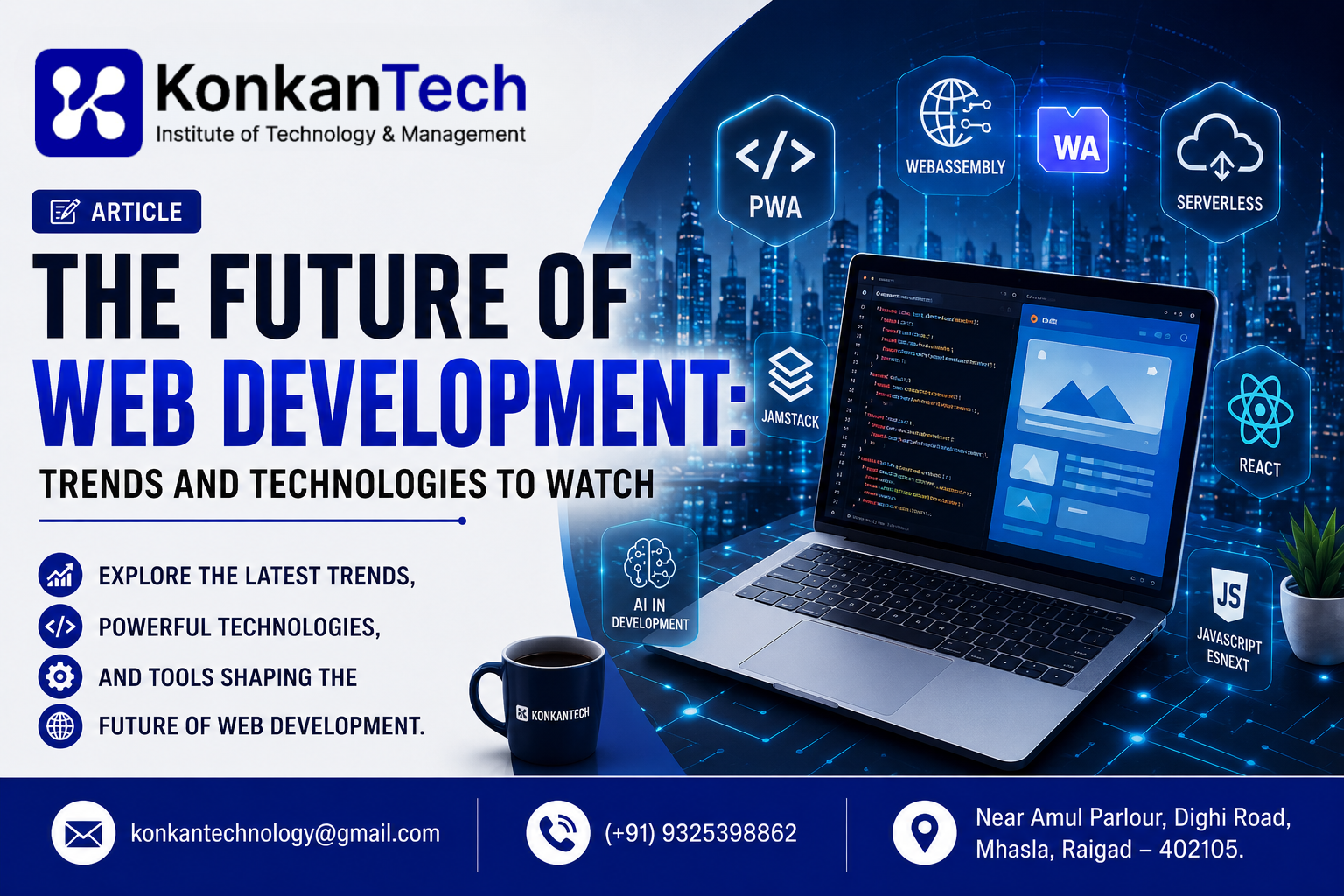
Web development is constantly evolving as new technologies, frameworks, tools, and development practices emerge. Websites and web applications have become essential for businesses, organizations, educational institutions, and individuals, making modern web development an important part of the digital world.
As user expectations continue to grow, developers need to understand emerging technologies and adapt to changing industry requirements. From Artificial Intelligence and cloud computing to progressive web applications and advanced security practices, several trends are shaping the future of web development.
Artificial Intelligence (AI) is becoming increasingly useful in web development. Developers can use AI-powered tools to assist with coding, debugging, content generation, testing, and website optimization.
AI can also help create personalized user experiences by analyzing user behavior and preferences. As AI technology continues to improve, its role in website and application development is expected to become more significant.
Progressive Web Applications (PWAs) combine features of traditional websites with capabilities commonly associated with mobile applications. PWAs can provide fast loading, responsive experiences, and access to certain features even when connectivity is limited.
They can be particularly useful for businesses that want to provide a mobile-friendly experience without developing separate applications for every platform.
Voice technology is changing the way users interact with digital platforms. Voice search and voice-enabled interfaces allow users to access information and perform certain actions using spoken commands.
Web developers increasingly need to consider conversational interfaces and voice-friendly experiences when creating modern websites and applications.
With users accessing websites from smartphones, tablets, laptops, and desktop computers, responsive web design has become essential.
Modern websites need to automatically adapt their layouts, images, navigation, and content to different screen sizes. A responsive website provides a consistent and user-friendly experience across multiple devices.
Cloud computing has transformed the way websites and web applications are developed, deployed, and maintained. Cloud platforms can provide scalable infrastructure, storage, databases, and development services.
Cloud-based solutions allow businesses to adjust resources according to demand and support applications that need to handle changing levels of traffic.
Application Programming Interfaces (APIs) allow different software systems and applications to communicate with each other. API-first development focuses on designing APIs as an important part of the development process.
This approach can make it easier to connect websites with mobile applications, third-party services, payment systems, databases, and other digital platforms.
As more personal and business information is handled online, cybersecurity has become a major priority in web development.
Developers need to consider secure authentication, data protection, access controls, secure coding practices, and regular security updates when building websites and web applications.
Strong security practices can help protect websites from common threats and create greater trust among users.
Modern websites are increasingly using animations, transitions, interactive elements, and visual effects to create engaging user experiences.
When used appropriately, interactive design can make websites easier to navigate and help guide users through important information without negatively affecting website performance.
Serverless architecture allows developers to build and run applications without managing traditional server infrastructure directly. Cloud providers handle much of the underlying infrastructure, while developers focus on application functionality.
This approach can help simplify deployment and allow applications to scale based on demand.
Low-code and no-code platforms allow users to create websites and applications with limited traditional programming. These tools can help businesses and non-technical users build digital solutions more quickly.
Although professional development skills remain important for complex projects, low-code and no-code tools can be useful for prototypes, internal applications, and simpler business solutions.
Website speed and performance remain important aspects of modern web development. Users expect websites to load quickly and respond smoothly across different devices and network conditions.
Developers are increasingly focusing on optimized images, efficient code, caching, faster hosting, and other performance improvements to create better digital experiences.
Web accessibility aims to make websites usable by as many people as possible, including individuals with disabilities.
Developers can improve accessibility through readable content, keyboard navigation, appropriate color contrast, alternative text for images, accessible forms, and properly structured web pages.
Accessibility-focused development can make websites more inclusive and easier to use.
Modern development frameworks increasingly use reusable components. Instead of building every part of a website from scratch, developers can create reusable interface elements and functionality.
Component-based development can improve consistency, reduce development time, and make large applications easier to maintain.
Headless architecture separates the front end of a website from the back-end content or services. This allows the same content to be delivered to websites, mobile applications, digital displays, and other platforms.
This approach can provide businesses with greater flexibility when managing content across multiple digital channels.
Web3 and blockchain-based technologies continue to attract interest within the technology industry. These technologies explore decentralized approaches to digital ownership, transactions, identity, and applications.
Although adoption varies across industries, developers may increasingly encounter blockchain-related technologies and decentralized applications in specialized areas of web development.
Web-based Augmented Reality (AR) can allow users to interact with digital elements through supported devices without necessarily installing a traditional application.
AR can have potential applications in areas such as e-commerce, education, real estate, product visualization, and marketing.
Security requirements are becoming more sophisticated as websites handle increasing amounts of sensitive information. Developers need to stay aware of emerging vulnerabilities and follow secure development practices.
Regular software updates, secure authentication, encrypted connections, access controls, and security testing can help create safer web applications.
Users increasingly expect digital experiences that are relevant to their interests and needs. Web applications can use user preferences and behavioral information to provide more personalized content and recommendations.
When implemented responsibly and with appropriate privacy considerations, personalization can improve user engagement and overall experience.
Automation is becoming an important part of modern development workflows. Automated testing, deployment, monitoring, code analysis, and other development processes can reduce repetitive tasks and improve efficiency.
Automation allows development teams to spend more time focusing on functionality, user experience, and problem-solving.
The future of web development is not only about adopting new technologies. User experience remains one of the most important factors in creating successful websites.
Websites should be fast, accessible, easy to navigate, mobile-friendly, secure, and visually clear. Technology should support the needs of users rather than making websites unnecessarily complicated.
A strong online presence can help businesses communicate with customers, promote their services, generate leads, provide information, and build credibility.
Modern web development enables businesses to create websites that are responsive, secure, scalable, and optimized for different devices and user requirements. Keeping a website updated with current technologies and development practices can also help businesses remain competitive in an increasingly digital environment.
The future of web development is being shaped by technologies such as Artificial Intelligence, cloud computing, Progressive Web Applications, automation, advanced cybersecurity, responsive design, accessibility, and personalized user experiences.
As technology continues to evolve, web developers and businesses need to stay informed about emerging trends while focusing on performance, security, accessibility, and user needs.
The most successful websites will not simply use the latest technology. They will combine appropriate technologies with thoughtful design and strong user experience to create useful, secure, and reliable digital platforms.
For more information about other technology services, you can contact us.
Phone: +91 9325398862 Email: konkantechnology@gmail.com Address: Near Amul Parlour, Dighi Road, Mhasla, Raigad – 402105 Working Hours: Monday–Saturday, 9:00 AM–8:00 PM